
ECE
Session Starts – August 2026
Duration – 4 Years
Residential Degree Program

Electronics and communication have become an integral part of nearly every domain on a worldwide scale. The Electronics Sector has had annual growth of 41% with new technology creating a wealth of opportunities for ECE Engineers.
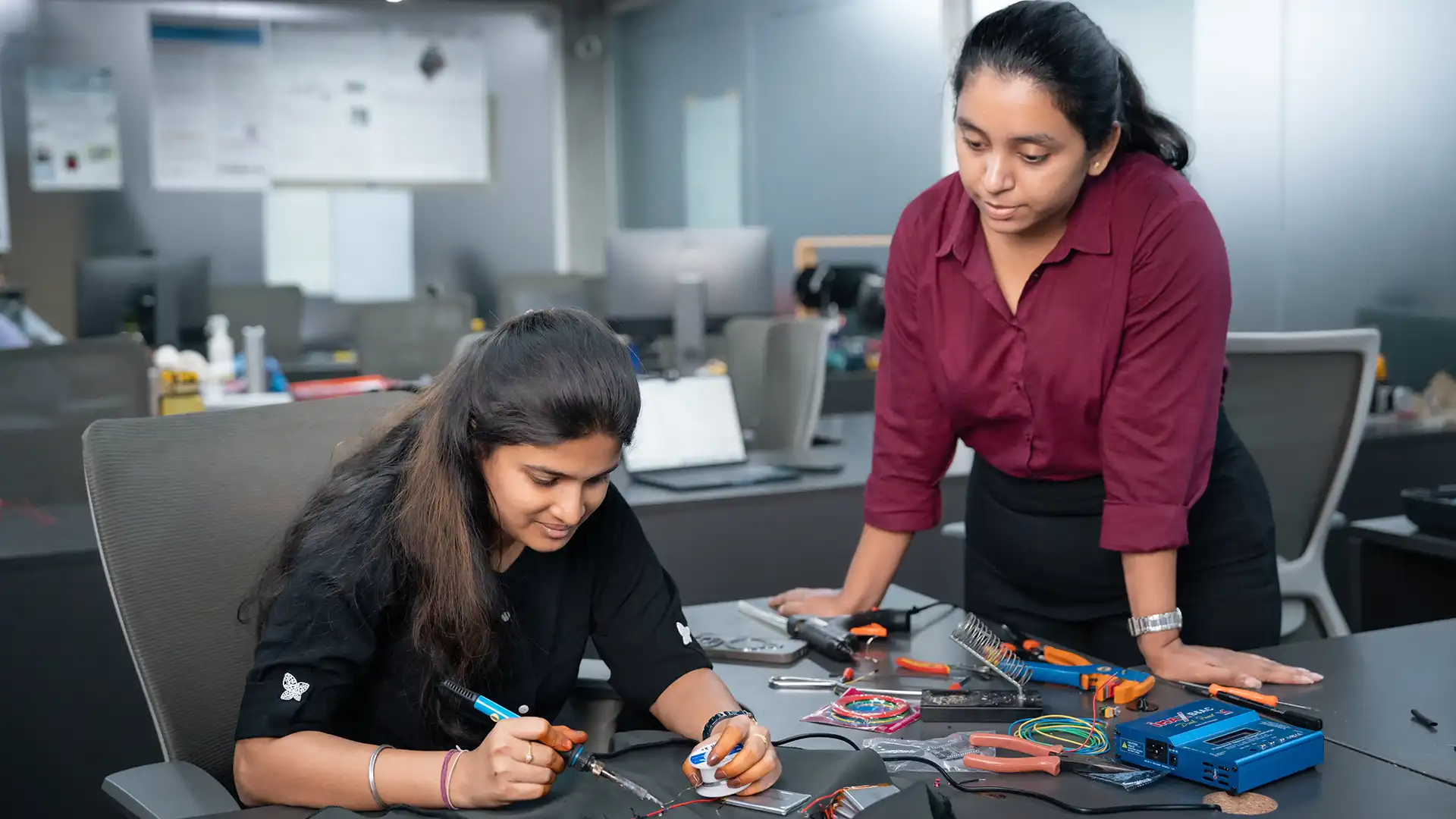
Electronics and Communications Engineering (ECE) is concerned with the study, design, development, and testing of electronics along with design and supervision of production of communications and broadcast systems. Woxsen’s B.Tech (ECE) provides a platform for being familiar with industry-level projects in order to learn about and be exposed to cutting-edge technologies and communications that are part of and growing in today's fast changing world.
Semester 1
+| Subject |
|---|
| Computational Thinking and Problem Solving |
| Computational Thinking and Problem Solving Practical |
| Engineering Mathematics - I |
| Design Thinking for Technologists |
| Applied Physics for Next Generation |
| Applied Physics for Next Generation Practical |
| Basic Electrical and Electronics Engineering |
| Basic Electrical and Electronics Engineering Practical |
| Environmental Science |
| Experiential Learning Project |
Semester 2
+| Course Title |
|---|
| Data Structures and Algorithms with Industry Applications |
| Data Structures and Algorithms with Industry Applications Practical |
| Electronic Devices and Circuits |
| Electronic Devices and Circuits Practical |
| Chemistry for Sustainable Future |
| Chemistry for Sustainable Future Practical |
| Communication skills for Engineers |
| Communication skills for Engineers Practical |
| Engineering Mathematics- II |
| Indian Knowledge Systems |
| Societal Internship Project |
Semester 3
+| Course Title |
|---|
| Fundamentals of Signals and Systems |
| Network Theory |
| Foundations of Artificial Intelligence |
| Probability Theory and Stochastic Processes |
| Analog and Digital Electronics |
| Industry Integrated Technical Writing |
| Advanced Communication and Logical Thinking |
| Conceptual Project – I |
Semester 4
+| Course Title |
|---|
| Electromagnetic Theory |
| Data Communication Networks |
| Machine Learning and Neural Networks |
| Embedded Systems and IoT |
| Control Systems and Robotics |
| Conceptual Project – II |
| Language and Critical Thinking |
| Numerical and Personality Refinement |
Semester 5
+| Course Title |
|---|
| Analog and Digital Communication |
| Applied Digital Signal Processing |
| Applicative Project – I |
| Advanced Wireless and Future Internet Technologies |
| Skill – Based Elective – I |
| Foundations of Identity and Communication |
Semester 6
+| Course Title |
|---|
| VLSI Design & Semiconductor Technology |
| Applicative Project – II |
| Discipline Specific Elective – I |
| Discipline Specific Elective – II |
| Skill – Based Elective – II |
| Software Engineering Studio |
Semester 7
+| Course Title |
|---|
| Capstone Project – I |
| Discipline Specific Elective – III |
| Open Elective |
| Skill – Based Elective – III |
| Global Elective |
Semester 8
+| Subject |
|---|
| Capstone Project – II |
| Skill – Based Elective – IV |
| Industry Internship |
Electives
+| Discipline Specific Electives |
|---|
| Deep Learning on NVIDIA Hardware |
| VLSI System on Chip Design |
| Industrial Automation |
| Speech Processing |
| IoT system Design |
| Specialized Communication (satellite+optics) |
| Biomedical Signal Processing |
| Radar Communications |
| Microwave Theory and Techniques |
| Edge Computing |
| Open Electives |
|---|
| Computer Vision |
| Natural Language Processing |
| Introduction to Generative AI |
| Explainable AI |
| Transmission and Distributed Networks |
| Power systems |
| Global Electives |
|---|
| AI for Business Intelligence and FinTech |
| Health & Wellness/Yoga education/ sports/ fitness |
| Urban Technology Challenge I |
| Industry-Defined Technical Challenge |
| Technology Venture Formation |
| Responsible Leadership |
| Reflecting Self |
| Existential Dialogue |
| Skill Based Electives |
|---|
| Ideation and Business Model Design |
| Proof of Concept and Technical Feasibility |
| Minimum Viable Product and User Validation |
| Market-Ready Product and Startup Launch |
| Research Foundations and Scientific Inquiry |
| Empirical Research Methods |
| Research Writing, Publishing and IP |
| Industrial Prototyping |
| India: Economy, Society & Development |
| Technical Communication |
| Engineering Aptitude |
| MLOps for Edge Computing |
| DevOps for Embedded Systems |
| Cybersecurity for IoT Networks |
| Prompt Engineering for Hardware Description |
Solve complex, new-age engineering problems by applying fundamental knowledge of mathematics, science, and engineering to come up with inventive solutions
Identification, Reviewing previously conducted studies, and Analysis of Industry 5.0 Engineering Problems to reach conclusions using the fundamental principles of mathematics, science, and engineering sciences
Understanding and recognising limitations while developing and applying available resources, techniques, and in-demand engineering tools to complex engineering activities
Engineering necessitates the application of ethical principles and a commitment to professional ethics, as well as taking on societal responsibilities and adhering to engineering norms
Harnessing the modern technologies to their full potential while understanding the societal and environmental impact of their solutions and demonstrating knowledge of sustainable practises for the safety and betterment of society
Evaluation of overall societal issues as well as the responsibilities that rise with them in the modern and professional engineering context by applying contextual information
Learn to identify, research, and analyse complex electronics and communication problems, as well as apply practical skills and knowledge in major Electronics and Communication streams such as VLSI, IoT, and Industrial Engineering
Learn to design components or procedures that meet defined needs and provide solutions to complex electronics and communication problems using technical knowledge and problem-solving skills
Develop and demonstrate skills in the development of methods, procedures, and solutions for the implementation of cost-effective and efficient decisions in the field of Electronics and Communication Engineering
Learn to devise, develop, and test diverse electronics and communication-based systems and equipments through IT workshop using MATLAB/Manufacturing Practices
Learn and understand the operation of analog and digital communication as well as network analysis through hands-on experience
Learn about purpose-built embedded systems for specific applications, as well as their optimizations resulting cost reduction and optimum resource consumption
Graduates of the B.Tech program will be able to apply their knowledge for developing novel solutions to the existing real-world problems and can look forward to a wide range of roles in advanced computing and related disciplines including:
What is BTech in Electronics & Communication at Woxsen University?
+BTech in Electronics & Communication at Woxsen University is an undergraduate engineering program focused on electronics, communication systems, circuits, embedded systems, signal processing, and modern engineering technologies.
How is BTech in ECE different from Computer Science Engineering?
+BTech in ECE focuses on electronics, circuits, communication networks, embedded systems, hardware, signals, and devices, while Computer Science Engineering focuses more on software, computing, algorithms, and programming. Both fields can overlap in areas like IoT, embedded software, and communication technologies.
Who should choose B.Tech Electronics and Communication Engineering?
+Students interested in electronics, devices, communication systems, hardware, robotics, embedded systems, semiconductor technologies, IoT, and signal-based technologies can choose B.Tech Electronics and Communication Engineering.
What subjects are commonly covered in BTech in ECE?
+BTech in ECE commonly includes electronic circuits, digital electronics, analog communication, digital communication, signals and systems, microprocessors, embedded systems, VLSI basics, control systems, electromagnetic theory, and project-based engineering learning.
What career options are available after BTech in Electronics & Communication?
+After BTech in Electronics & Communication, students can explore roles in electronics design, embedded systems, telecom, IoT, semiconductor support, hardware testing, communication systems, automation, software-related roles, research, and higher studies.
Why is ECE still relevant in emerging technology careers?
+ECE remains relevant because modern technologies depend on electronics, communication networks, embedded systems, sensors, chips, connected devices, automation, and IoT. ECE students can work across hardware, software, communication, and intelligent device ecosystems.
What should students check before selecting a BTech in ECE college?
+Students should check curriculum, electronics labs, communication labs, project work, faculty expertise, industry exposure, internships, placement support, research opportunities, and exposure to emerging areas like IoT, embedded systems, and semiconductors.
How can students apply for B.Tech ECE at Woxsen University?
+Students can apply by visiting the official Woxsen University B.Tech ECE page, checking eligibility and admission details, reviewing the course structure, preparing required documents, and following the application process mentioned by the university.
Login to your application page to start your application and reserve your place in the class of 2026
 Apply Now
If you would like to speak to a admission counsellor, please connect with us on WhatsApp
 Talk Now
*25% seats for admissions are reserved for the students of the State of Telangana under the domicile-based reservation clause mentioned in The Telangana State Private Universities (Establishment and Regulation) Act, 2018.




 Pay Fee
 Apply
Apply Chat
Chat Enquire
 Download Now